An Insurrection 25 Years in the Making
The wheels bounced and the brakes screeched as the plane touched down at Fort Lauderdale-Hollywood International Airport.
But it wasn’t Spring Break.
It was just days since the 2000 Presidential Election. I was one of hundreds of partisans who descended on the state of Florida to help secure the presidency for my candidate by participating in a recount. What has now become evident more than twenty years later is that the saga that was the presidential election of 2000 unwittingly influenced the insurrection of January 6th, 2020.
Man-Made Disaster.
My traveling companions and I had just completed a grueling and mostly disappointing election cycle as operatives with the Tennessee Republican Party. Having spent thousands targeting seven state senate seats, which were all losing efforts, and barely maintaining our numbers in the state House, we were haggard, demoralized, and exhausted. But there was reason for hope.
Vice President Al Gore had lost his home state of Tennessee, and its eleven electoral votes, to George W. Bush thrusting Florida and its then-antiquated voting process into the international spotlight. Our band of melancholy men were among those recruited from both national party organizations to assist in “monitoring” the recounts in multiple counties. We would soon learn that our real role was to help build the legal case for Governor Bush to hang on to his razor-thin 900-vote lead.
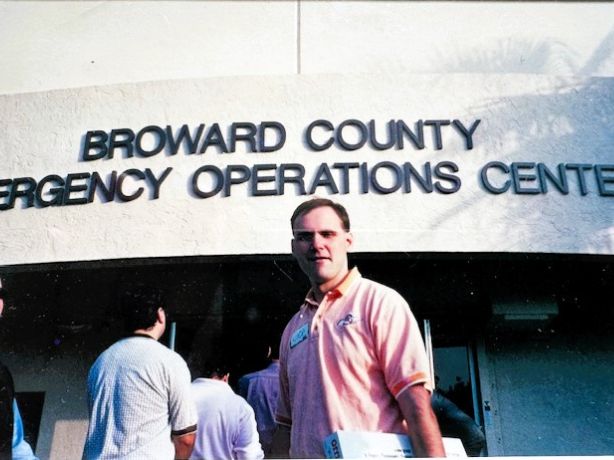
After picking up the undersized rental car, we squeezed together and made the short, but sweltering drive to the staging location for the recount. Fittingly, the recount was housed at the Emergency Operations Center where emergency management officials coordinated responses to natural disasters. We took our places in a long line of partisans submitting to security screenings necessary to enter the building.
Getting to Know Chads
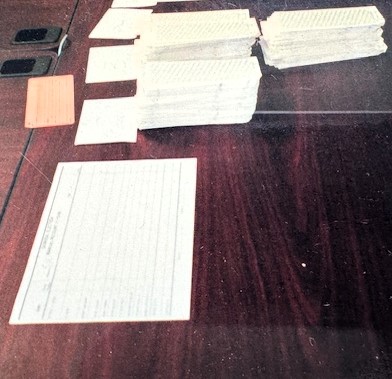
The central command walls in the underground bunker were plastered with televisions broadcasting coverage of the election day debacle. Long tables and chairs neatly organized in multiple T-shapes filled the gymnasium-sized space. Atop each table was a stack of manilla-colored cards and various official-looking papers. Each table was outfitted with four chairs. After a brief training session, I learned the two center seats were for Broward County election workers. The seat on the left was for the Democratic party representative and the seat on the right was for the GOP’s representative.
The manilla cards were called punch cards. When new, the cards were overlaid with numbers in black type. The numbers coincided with a specific candidate for office. At the polls, the cards were placed into the voting machines, and the numbers were expected to line up with the names of each candidate assigned to that number, though they didn’t always neatly align. For example, George W. Bush was number one and Al Gore was number two. A voter desiring to cast a ballot for Vice President Gore would punch out the number 2 with a stylus. The residual tiny, manilla rectangles of card stock produced from the punching were known as Chads.
The infamy of chads stems from the diversity of their “species.” All chads were not the same. A hanging chad clung to a single corner of the punch card. A swinging chad held on to two corners. A tri-chad grasped three corners. And a chad that bulged, but remained connected to all four corners was known as dimpled if slightly bulging and pregnant if it appeared ready to pop. Of course, the fate of our nation depended on the decision of whether these chads in their various conditions should be counted as votes despite the fact they were not completely punch out. In essence, we were being asked to retroactively read the minds of voters.
Documenting the Undignified
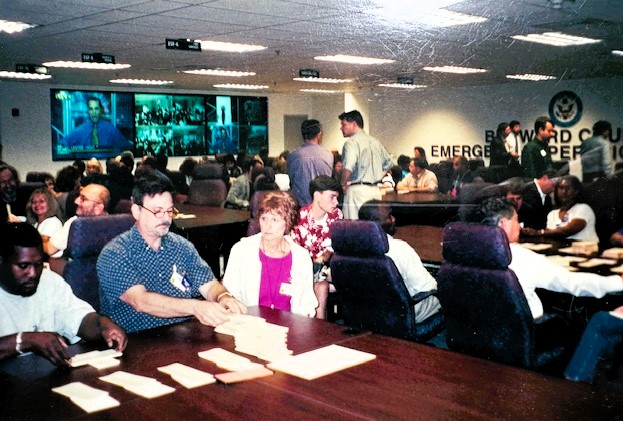
Eight hours per day for 5 days with short breaks every few hours, my Democratic counterpart, two election workers, and I stared through the rectangular openings in the punch cards into the florescent ceiling lights of the hurricane bunker. We were all required to agree that an opening indicated a vote for Bush or a vote for Gore, otherwise the card was sent to the canvassing board for a decision.
At the end of the day, with bleary eyes and numb glutes, we trudged to our respective holding areas. In the GOP room, we were required to immediately line up and tell our stories to one of four or five attorneys sitting at folding tables typing any indiscretion into their laptops.
During my short stint, I witnessed:
- a chad eaten by a Democratic operative as a GOP operative tried to photograph it with a disposable camera;
- an election worker, who must have been an avid Bridge player, shuffle a stack of punch cards causing chads to detach and fall on the table; and
- most egregious, representatives from both parties routinely challenging clear votes for their opponents to further muck up the process.
Outside of the bunker, the media and throngs of protesters kept vigil waiting for any news to shift the momentum in favor of one candidate or the other. Local courtrooms, the state Supreme Court in Tallahassee, and U.S. District Courts were teeming with lawyers filing motions and articulating legal theories to hand their side a victory.
More than once, I heard Democrats and Republicans say,
“This is a helluva way to choose a president!”
And then, almost immediately afterwards say something like,
“But at least we’re not like those countries who take control of the government by violence.”
The Insurgency Playbook
Now, nearly a quarter of a century later, the cringe worthiness of the 2000 election feels dignified – at least in comparison to events of January 6, 2021.
The 2000 recount saga was rife with drama and intrigue, but the only event resembling a riot was a group of protestors bent on stopping the recount in Miami-Dade County. Led by Republican congressional staffers in their Capitol Hill attire, the protest was dubbed the “Brooks Brothers Riot.”
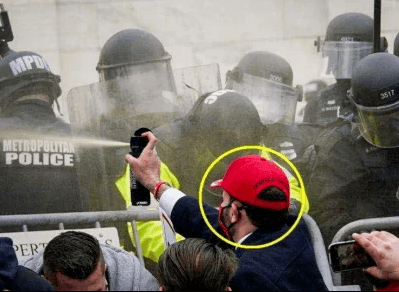
Law enforcement officers weren’t attacked, beaten, or disabled with bear spray. There were no overt attempts to hang the Vice President or take the Speaker of the House hostage. No protestors were killed by police for failing to halt while breaching locked Capitol doors. A fraudulent slate of electors never surfaced, and neither of the candidates publicly goaded supporters into storming any government building. But remnants of the 2000 election fiasco can be found in the beliefs about and tactics of January 6.
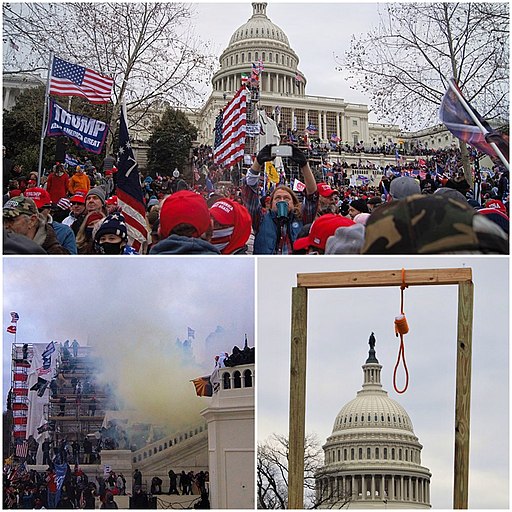
Following the Florida recount, citizens came to believe that a presidential election could be stolen, Republicans claimed Democratic election workers in Broward, Palm Beach, and Miami-Dade were stealing votes from George W. Bush’s winning margin. Democrats asserted that Republicans, with the help of GOP Secretary of State, Katherine Harris, had already stolen the election from Vice President Gore.
The widespread conspiratorial mentality didn’t end when the U.S. Supreme Court ruled in favor of George Bush on December 12, 2000, effectively handing him the presidency. States scrambled to shore up their voting processes and systems over the next several years. Media outlets, universities, and interested organizations attempted to complete the recount after the fact failing to reach a consensus about who won. The fear of how close Republicans came to having the 2000 election “stolen” continued to fester.
In a 5-4 decision, the United States Supreme Court found in favor of George W. Bush, which stopped the recount in Florida. Florida’s twenty-seven electoral votes were awarded to Bush giving him the 271 votes necessary to win the Electoral College. What the Trump campaign knew in 2020 was that they had a hand-picked Supreme Court majority greater than the one the Bush campaign enjoyed twenty years prior. If just one case found its way to the Court, the “brain trust” believed the conservative-leaning body would tilt their way.
Trump’s legal team filed 62 lawsuits in the week following the election. Fifty were dismissed by mid-December. Texas Attorney General, Ken Paxton, a Trump acolyte, petitioned the U.S. Supreme Court to hear a case the Trump campaign supported. On December 11, the Trump-stacked court declined to hear the case. At least six times, the Trump Campaign filed Writs of Certiorari asking the court to expedite its consideration of various cases, but by January 6, the high court had failed to rule. (The court rejected all six requests on January 11.)
The final ploy from the 2000 recount was intimidation. The “Brooks Brothers Riot,” organized, at least in part, by Roger Stone, had succeeded in stopping the Miami-Dade recount. If several hundred protesters waving signs and banging on doors could stop a recount with national implications, imagine what thousands of partisans from across the country could accomplish. We now know that those fanatics stormed the Capitol equipped with zip ties, weapons, and vastly more violent rhetoric than their predecessors. Perhaps most importantly, they had the near explicit directive of their leader.
The Trump Organization didn’t sit down with the 2000 recount playbook and decide to put those tactics on steroids. What they knew is that the boundaries of audacity, tolerance for misbehavior, and trust in our government institutions stretched and never snapped back into place.
Retrofitting Our Democracy
On January 6th, our democratic sensibilities were challenged again. For many, mistrust of government reached the point of a violent overthrow. Misbehaving to the level of breaking the law was justified by the ends. And the audacity to clamor for a coup was mistaken for the courage of patriots.
Now, with the 2024 election looming, it is no wonder anxiety is high and talk of more widespread violence is common. For almost 250 years, the elasticity of the Republic and the Constitution through national crises has been nothing short of remarkable. But it is not unbreakable.
Periodically, the foundations of centuries-old structures need reinforcing as cracks appear and existential threats surface – such is the situation with our democracy. Retrofitting our republic requires an outright rejection of another Trump presidency this November.
#Trump #Trump2024 #PresidentialElection #Biden #PresidentBIden #2024Election #RogerStone #Insurrection #January6 #CapitolRiot

 Dad Sense
Leave a comment